

A leaking inflatable seal rarely fails without warning. It starts small — a slight pressure loss here, a maintenance ticket there, equipment cycles that run a little longer than they used to. Eventually it turns into unplanned downtime, and by then everyone’s asking the same question: why did this seal fail so early?
- Why Material Selection Determines Inflatable Seal Performance
- Factors Engineers Should Evaluate Before Selecting Inflatable Seal Materials
- Silicone Inflatable Seals
- EPDM Inflatable Seals
- Viton (FKM) Inflatable Seals
- Neoprene Inflatable Seals
- A Common Misconception Worth Correcting
- Material Comparison Table
- Industry Applications
- Common Mistakes When Selecting Inflatable Seal Materials
- Why Custom Inflatable Seals Deliver Better Performance
- How Western Polyrub Engineers Custom Inflatable Seals
- Frequently Asked Questions
- The Bottom Line
In most cases, the honest answer isn’t poor equipment design. It’s the elastomer. A seal built from the wrong material for its actual operating environment is set up to underperform from the day it’s installed, no matter how well the equipment around it was engineered.
Whether your application involves aggressive chemicals, high temperatures, steam sterilization, or constant outdoor exposure, the material behind the seal — Silicone, EPDM, Viton, or Neoprene, among others — is what actually determines whether it holds up for years or fails within months. This guide walks through how to choose correctly.
Why Material Selection Determines Inflatable Seal Performance
An inflatable seal’s material affects far more than just how it looks on a spec sheet. It governs pressure retention over time, how well the seal stays flexible through thousands of inflation cycles, resistance to fatigue as it flexes repeatedly, how it holds up against whatever chemicals or media it’s exposed to, resistance to compression set — the permanent deformation that slowly kills sealing performance — and general aging under whatever environmental conditions it’s actually installed in.
Get the material wrong, and even a perfectly engineered seal geometry won’t save it. Get it right, and a well-chosen elastomer can outlast a poorly matched premium material by a wide margin.
Factors Engineers Should Evaluate Before Selecting Inflatable Seal Materials
Before landing on a material, it’s worth working through the full picture: operating temperature across the complete cycle, required pressure rating, chemical compatibility with actual process media, UV exposure if the application is outdoors, ozone resistance for anywhere ozone-generating equipment is nearby, whether FDA compliance is required, abrasion resistance for dynamic applications, resistance to compression set for long-term sealing performance, how frequently the seal will actually inflate and deflate, and how the equipment itself is designed around the seal.
Skipping any one of these tends to surface later as an early failure that looked, at first glance, like a manufacturing defect but was really a specification gap.
Silicone Inflatable Seals
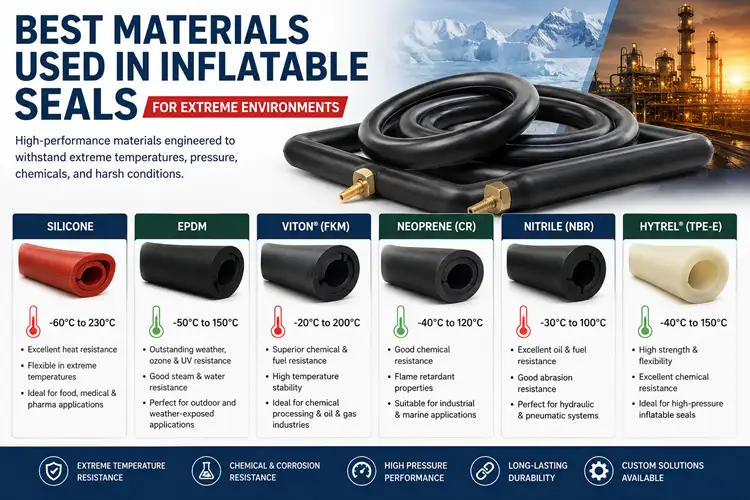
Silicone (VMQ) is the material most engineers reach for when FDA compliance and a wide temperature range both matter. It performs reliably from deep cold up through very high heat, which makes it a natural fit for medical equipment, food processing, and cleanroom applications where both purity and thermal stability are non-negotiable.
Where it shines: FDA-grade compliance, broad temperature tolerance, genuine flexibility, and low toxicity — the combination that makes it the default choice across pharmaceutical, food, and medical applications.
Where it falls short: oil resistance is genuinely poor, and tear strength runs lower than some of the alternatives. Silicone isn’t the material to reach for in an oil-heavy environment just because of its strong reputation elsewhere.
EPDM Inflatable Seals
EPDM earns its place through excellent steam, water, and weathering resistance — a combination that makes it a workhorse across HVAC, water treatment, and pharmaceutical applications where those specific exposures dominate.
Where it shines: steam resistance, strong outdoor weathering performance, solid ozone resistance, and a reasonable cost relative to premium alternatives.
Where it falls short: petroleum resistance is poor. EPDM breaks down quickly around oils, fuels, and hydrocarbons, so it’s simply the wrong choice anywhere those are present, regardless of how well it performs elsewhere.
Viton (FKM) Inflatable Seals
Viton is the material engineers reach for when the operating environment is genuinely hostile — chemical plants, oil and gas facilities, fuel handling systems, and anywhere acids, solvents, or high temperatures would degrade a standard elastomer quickly.
It costs more than the alternatives, and that’s worth acknowledging directly rather than glossing over. But in genuinely demanding chemical or high-temperature environments, that higher upfront cost is usually offset by a longer service life, less frequent maintenance, and a stronger return on investment over the equipment’s working life — because the alternative is a seal that needs replacing every few months instead of every few years.
Neoprene Inflatable Seals
Neoprene (CR) fills a specific niche: outdoor machinery, marine equipment, and general industrial applications where moderate chemical exposure and weather resistance matter more than extreme chemical or temperature performance.
It’s a genuinely cost-effective choice for applications that don’t need the premium performance of Viton or the FDA compliance of silicone — solid all-around weather resistance at a price point that makes sense for general-purpose outdoor and industrial use.
A Common Misconception Worth Correcting
Here’s something worth stating plainly, because it trips up more engineers than it should: the “best” material by reputation isn’t always the best material for a specific job.
Silicone isn’t the best choice for chemical resistance — Viton is. Viton isn’t actually the top performer for steam resistance — EPDM handles that better. And EPDM isn’t the material to reach for when oil resistance is the priority — that’s squarely NBR or Viton territory. Each material has a genuine specialty, and assuming one premium elastomer is simply “better” across the board leads to exactly the kind of mismatched specification that causes early failures.
Material Comparison Table
| Material | Temperature | Pressure Handling | FDA Compliant | Steam Resistance | Oil Resistance | Chemical Resistance | Outdoor/Weather | Cost | Best Applications |
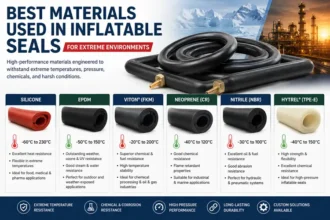
| Silicone | -60°C to 230°C | Moderate | Yes | Good | Poor | Moderate | Excellent | Higher | Pharma, food, medical, cleanrooms |
| EPDM | -50°C to 150°C | Good | Limited | Excellent | Poor | Good | Excellent | Moderate | Water treatment, HVAC, pharma |
| Viton (FKM) | -20°C to 200°C | Excellent | Limited | Good | Excellent | Excellent | Good | Highest | Chemical plants, oil & gas, fuel handling |
| Neoprene | -40°C to 120°C | Good | No | Moderate | Good | Moderate | Good | Lower | Marine, outdoor machinery, general industry |
Industry Applications
Inflatable seal materials get matched to industry based on what each environment actually demands. Food processing and pharmaceutical manufacturing lean heavily on FDA-grade silicone and EPDM. Medical devices depend on silicone’s purity and temperature range. Chemical plants and oil and gas operations need Viton’s chemical resistance. Vacuum chambers and semiconductor equipment require precision sealing with minimal particle generation, typically silicone or EPDM depending on the specific process. Packaging and battery manufacturing often use EPDM or silicone depending on environmental control needs. Aerospace and defense applications frequently demand Viton’s temperature and chemical tolerance. Water treatment relies on EPDM’s steam and weathering performance. Automotive manufacturing spans a mix, often NBR or Viton depending on oil exposure.
Common Mistakes When Selecting Inflatable Seal Materials
The same avoidable mistakes show up repeatedly: specifying the wrong hardness for the application, choosing a temperature rating based on average conditions rather than actual peak exposure, ignoring chemical compatibility until it’s already caused swelling or degradation, underestimating how frequently the seal will actually inflate and deflate over its service life, overlooking UV exposure for anything outdoor-facing, skipping FDA requirements that turn out to be necessary, not properly accounting for pressure rating with a real safety margin, and ignoring compression set resistance — which quietly undermines even a chemically well-matched material over time.
Why Custom Inflatable Seals Deliver Better Performance
A standard, catalog inflatable seal is built to an average spec. Custom inflatable seals solve the gaps a standard part leaves behind through OEM-specific design, custom geometry matched to the actual equipment, material blending or compound selection tuned to real operating conditions, pressure optimization for the specific application, and real prototype testing before full production.
The payoff shows up directly in reduced downtime and a genuinely longer service life — because the seal was engineered for the actual environment it’s operating in, not a generic approximation of it.
How Western Polyrub Engineers Custom Inflatable Seals
Western Polyrub India Pvt. Ltd. brings more than 30 years of experience to exactly this kind of material and design decision — custom molded inflatable seals, FDA-compliant compound development, bonded seal capability, real prototype development before committing to full production, in-house tooling, genuine quality inspection, and OEM manufacturing built around the specific application rather than a generic part number.
Frequently Asked Questions
Which material is best for inflatable seals? It depends entirely on the application — silicone for FDA and high-temperature purity-sensitive use, EPDM for steam and weathering, Viton for aggressive chemicals, and Neoprene for general outdoor use.
What is the difference between EPDM and Viton inflatable seals? EPDM offers excellent steam and weather resistance at a lower cost, while Viton offers superior chemical resistance and handles more aggressive environments, at a higher price.
Are silicone inflatable seals FDA approved? FDA-compliant silicone compounds are widely available and commonly used in food, pharmaceutical, and medical applications, though the specific formulation determines actual compliance.
Which inflatable seal material has the highest temperature resistance? Silicone offers one of the widest overall temperature ranges, though Viton also performs well at high temperatures with the added benefit of stronger chemical resistance.
Which rubber is best for chemical processing? Viton (FKM) generally offers the strongest resistance to aggressive chemicals and solvents among common inflatable seal materials.
How long do inflatable seals last? It depends on material, pressure, and cycle frequency, but a properly specified seal typically outlasts a mismatched one by a significant margin.
What causes inflatable seal failure? Most commonly the wrong material for the application, incorrect pressure rating, unaddressed chemical exposure, or compression set building up over time.
Can inflatable seals withstand steam sterilization? Yes — EPDM and silicone both offer strong steam resistance suited to sterilization and autoclave applications.
Which material is best for outdoor applications? EPDM and Neoprene both offer strong weather and UV resistance, with EPDM typically providing better ozone resistance for long-term outdoor use.
How do I choose the right inflatable seal material? Work through operating temperature, pressure, chemical exposure, UV and ozone exposure, and FDA requirements together, rather than defaulting to whichever material seems most “premium.”
Are custom inflatable seals better than standard seals? For most demanding applications, yes — custom seals are engineered around the actual operating conditions rather than an average specification, which reduces failure risk significantly.
Can inflatable seals be manufactured for OEM equipment? Yes — profile, material, inflation pressure, and mounting configuration can all be custom engineered around a specific piece of OEM equipment.
The Bottom Line
The right inflatable seal material isn’t the one with the strongest reputation — it’s the one actually matched to your operating environment. Silicone, EPDM, Viton, and Neoprene each have a genuine specialty, and understanding those differences is what separates a seal that lasts for years from one that needs replacing every few months.
Not sure which material actually fits your application? Western Polyrub India Pvt. Ltd. brings over 30 years of experience helping engineers select and custom-engineer the right inflatable seal material for extreme or demanding environments. Request a custom quote to get a straight answer built around your actual operating conditions.