


Most industrial diaphragm failures don’t actually begin in the field. They begin during manufacturing — inconsistent curing, the wrong material for the application, fabric reinforcement that wasn’t placed quite right, or a mold design that was close but not exact. By the time the diaphragm fails months later, the root cause is long buried under whatever operating conditions get blamed instead.
- How Rubber Diaphragm Manufacturing Has Changed Over the Last Decade
- Understanding the Modern Rubber Diaphragm Manufacturing Process
- Compression Molding vs Injection Molding vs Transfer Molding
- Latest Innovations Transforming Rubber Diaphragm Manufacturing
- Material Innovations Improving Rubber Diaphragm Performance
- Precision Testing Technologies Used by Leading Manufacturers
- Industry 4.0 and Smart Manufacturing
- How Manufacturing Technology Improves OEM Performance
- What to Look for in a Modern Rubber Diaphragm Manufacturer
- Future Trends in Rubber Diaphragm Manufacturing
- Frequently Asked Questions
- The Bottom Line
Rubber diaphragm manufacturing has moved well past basic molding over the last decade. Precision engineering, more advanced elastomer science, automated inspection, and tighter process control now combine to produce diaphragms that genuinely hold up through millions of operating cycles — but only when the manufacturing process behind them actually uses these advances rather than relying on outdated methods and calling it “custom.”
This piece focuses on the two manufacturing processes that matter most — compression molding and injection molding — and the material advancements that are changing what diaphragms are actually capable of.
How Rubber Diaphragm Manufacturing Has Changed Over the Last Decade
Traditional diaphragm manufacturing relied heavily on manual mold setup, less precise tooling, and inspection that mostly happened after the fact. Precision-engineered manufacturing looks different at nearly every step: CAD design lets engineers model the exact diaphragm geometry before a mold is ever cut, simulation predicts how the part will perform under real pressure before physical testing even starts, digital mold design and CNC machining deliver tolerances traditional tooling methods couldn’t reliably hit, and automated molding processes produce far more consistent parts run after run than manual methods ever could.
The net effect is fewer surprises after the diaphragm is already in service — because more of the actual engineering happens before the mold is cut, not after a batch of underperforming parts shows up.
Understanding the Modern Rubber Diaphragm Manufacturing Process
Product design starts with CAD modeling, finite element analysis (FEA) to predict stress points, and pressure simulation to validate the geometry before any tooling gets built.
Material engineering comes next — selecting between EPDM, silicone, NBR, FKM, Neoprene, or natural rubber based on the application’s actual chemical compatibility, temperature range, pressure requirements, and FDA compliance needs, rather than defaulting to whatever’s been used before.
Tool design determines how consistently the final parts will actually perform. CNC-machined molds, multi-cavity tooling for volume production, precision tooling tolerances, and mold flow optimization all directly affect dimensional consistency from the first part to the ten-thousandth.
Rubber mixing blends the base polymer with fillers, accelerators, carbon black or silica, and the cure system that determines how the compound behaves once it’s molded and vulcanized. Getting this formulation right is as much a part of “manufacturing technology” as the mold itself.
Fabric reinforcement, where the application calls for it, embeds nylon, polyester, Kevlar, or aramid fabric into the elastomer. This is what actually improves burst pressure, extends fatigue life under repeated cycling, and helps the diaphragm hold its shape and flexibility over a much longer service life than an unreinforced part could manage.
Rubber-to-metal bonding, when the design requires it, uses chemical bonding, mechanical locking, or careful surface preparation to permanently join rubber to a metal component — common in diaphragms that need a rigid center section or mounting interface.
Compression Molding vs Injection Molding vs Transfer Molding
This comparison matters more than almost anything else in this article, because the manufacturing process itself shapes what the final diaphragm is actually capable of.
| Process | Advantages | Limitations | Best Applications | Production Volume | Cost | Precision | Cycle Time | OEM Suitability |
| Compression Molding | Excellent for thick sections and fabric-reinforced parts; lower tooling cost | Longer cycle times; less suited to very high volumes | Reinforced diaphragms, thicker profiles, custom low-to-mid volume runs | Low to moderate | Lower | Good | Longer | Strong for custom and reinforced designs |
| Injection Molding | Fast cycles, excellent dimensional consistency, ideal for high volume | Higher tooling investment upfront | High-volume precision diaphragms, tight-tolerance parts | High | Higher upfront, lower per-part at volume | Excellent | Shorter | Strong for large-volume OEM programs |
| Transfer Molding | Good balance of precision and flexibility; handles inserts well | Slower than injection, more material waste than both | Diaphragms with metal inserts or bonded components | Moderate | Moderate | Very good | Moderate | Strong for bonded or insert-molded designs |
Compression molding remains highly relevant for a lot of diaphragm designs — particularly anything fabric-reinforced or built with thicker cross-sections, where the process’s ability to handle reinforcement layers cleanly is a genuine advantage. It’s also often the more economical choice for custom, lower-volume OEM runs where injection tooling costs wouldn’t be justified.
Injection molding takes over where volume and dimensional consistency matter most. Once tooling is built, it delivers extremely consistent parts at speed — the right choice for OEM programs running large production volumes where part-to-part consistency directly affects assembly line reliability.
Transfer molding sits between the two, handling diaphragms with bonded metal inserts or other embedded components more cleanly than either compression or injection molding typically can on their own.
Choosing the right process isn’t about which one is objectively “best” — it’s about matching the process to the diaphragm’s actual design, reinforcement requirements, and production volume.
Latest Innovations Transforming Rubber Diaphragm Manufacturing
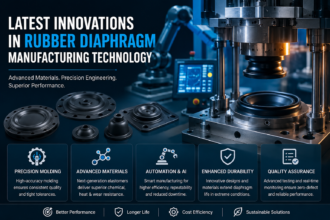
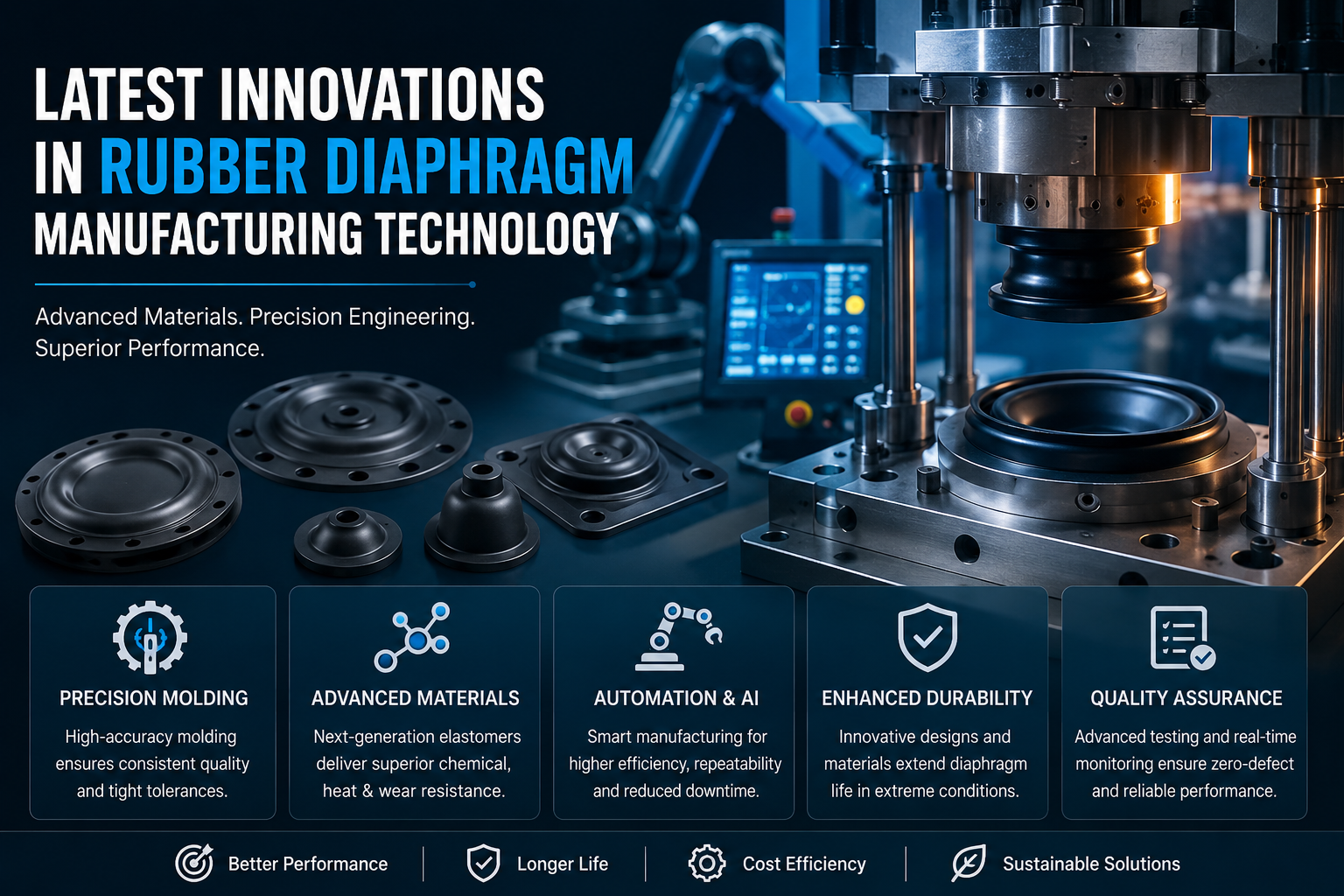
A handful of technologies are genuinely changing what’s possible at the manufacturing level. AI-assisted process monitoring is being used to predict defects before they happen and optimize cure parameters in real time, which reduces scrap and improves consistency batch to batch. Smart compression molding and automated injection molding systems, often paired with robotics for material handling, cut variability that used to come from manual process steps. Machine vision inspection and laser measurement now catch dimensional and surface defects that manual inspection would miss entirely. Digital traceability tracks a diaphragm’s full production history, which matters enormously for regulated industries needing batch documentation. Automated mixing systems improve compound consistency, and energy-efficient curing methods are cutting both cost and environmental impact.
Automation, AI-driven process optimization, virtual manufacturing, and energy-efficient production are consistently cited across the industry as the strongest trends shaping where diaphragm manufacturing is headed next.
Material Innovations Improving Rubber Diaphragm Performance
This is where a lot of the real performance gains are actually happening, sometimes more than the molding process itself.
Newer EPDM, FKM, HNBR, and silicone formulations are being engineered specifically for lower compression set — meaning the diaphragm holds its sealing force longer instead of gradually losing it over repeated cycles. Nano-filled elastomer compounds are improving mechanical strength and wear resistance without sacrificing flexibility. Chemical-resistant compound development continues to push the boundaries of what a single material can handle, narrowing the gap between “general purpose” and “specialty” elastomers in some applications. Food-grade and medical-grade compounds are being formulated with tighter purity control, supporting stricter FDA and biocompatibility requirements. And thermoplastic elastomers (TPE) are increasingly viable for specific diaphragm applications where their unique processing characteristics offer real advantages over traditional rubber compounds.
The practical impact of all this: diaphragms built today, from the right manufacturer with access to these material advances, can genuinely outperform equivalent parts built even five or ten years ago — not because the geometry changed, but because the material science behind the compound did.
Precision Testing Technologies Used by Leading Manufacturers
None of these manufacturing and material advances mean much without real validation behind them. Leading manufacturers rely on burst testing, pressure testing, leak testing, fatigue and cycle testing, accelerated aging studies, temperature testing across the full rated range, chemical resistance testing against actual process media, dimensional inspection, vision inspection for surface defects, and hardness, tensile strength, and compression set testing to confirm the part performs the way its spec sheet claims — not just the way it was designed to.
Industry 4.0 and Smart Manufacturing
Diaphragm manufacturing is increasingly connected to broader Industry 4.0 practices — IoT-enabled equipment collecting real-time production data, predictive maintenance on the manufacturing equipment itself, digital twins used to simulate and validate designs before physical production, manufacturing execution systems coordinating the full production workflow, and real-time production monitoring that catches process drift before it produces a batch of out-of-spec parts.
For OEM buyers, this translates into something concrete: more consistent parts, better documentation, and a manufacturer who can actually show, rather than just claim, that their process is under control.
How Manufacturing Technology Improves OEM Performance
All of this technology exists for one practical reason — better outcomes for the equipment the diaphragm goes into. That means longer service life, lower downtime, more consistent dimensions from part to part, reduced leakage, better pressure handling, lower maintenance costs over the equipment’s life, stronger repeatability across production runs, and fewer warranty claims tracing back to the diaphragm itself.
For OEMs building equipment meant to run reliably for years, that last point matters more than it might seem — a manufacturing process with real process control produces fewer surprises in the field, which is worth more than a lower unit price on a part that fails early.
What to Look for in a Modern Rubber Diaphragm Manufacturer
A genuine modern manufacturer should offer real in-house mold shop capability, actual rubber compounding rather than buying pre-made stock material, fabric reinforcement expertise, rubber-to-metal bonding, PTFE bonding options where needed, real material testing infrastructure, burst testing, FDA-compliant materials where required, ISO quality certification, genuine OEM engineering support, custom tooling capability, rapid prototyping, and export experience if you’re sourcing across regions.
Western Polyrub India Pvt. Ltd. brings decades of experience across exactly this list — in-house tooling and compounding, both compression and precision molding capability, fabric reinforcement and bonding expertise, and real testing and quality validation behind every custom diaphragm produced.
Future Trends in Rubber Diaphragm Manufacturing
Looking ahead, the direction is fairly clear: AI-driven quality control catching defects earlier in the process, digital twin manufacturing becoming more standard for design validation, expanded use of robotics on the production floor, smart elastomer compounds engineered for specific performance targets, growing interest in bio-based and more recyclable rubber compounds, predictive quality systems that flag problems before they produce bad parts, early experimentation with 3D-printed tooling for rapid prototyping, and a broader industry push toward zero-defect manufacturing as the real target rather than an aspiration.
Advanced molding technologies are increasingly centered on automation, more sustainable production methods, tighter process control, and elastomer formulations engineered for specific performance needs rather than general-purpose use.
Frequently Asked Questions
What is the best manufacturing process for rubber diaphragms? It depends on the design — compression molding suits fabric-reinforced or thicker diaphragms and lower volumes, while injection molding suits high-volume, tight-tolerance production.
What is compression molding? A process where rubber compound is placed in a heated mold cavity and compressed to form the part, well suited to reinforced and custom diaphragm designs.
What is injection molding for rubber diaphragms? A process where rubber compound is injected into a closed mold under pressure, offering fast cycle times and excellent dimensional consistency for high-volume production.
Which rubber material lasts the longest? It depends on the application — Viton typically lasts longest in aggressive chemical exposure, while silicone and EPDM lead in temperature and weathering-focused applications.
What is a fabric reinforced rubber diaphragm? A diaphragm with reinforcement fabric like nylon, polyester, or aramid embedded in the elastomer, improving burst pressure and fatigue life under repeated pressure cycling.
What testing is performed on industrial rubber diaphragms? Burst, pressure, leak, fatigue, cycle, accelerated aging, temperature, chemical resistance, dimensional, and hardness testing are all standard validation methods.
How long does a rubber diaphragm last? It varies by material, manufacturing process, and operating conditions, but properly engineered diaphragms can reliably handle millions of cycles.
What industries use custom rubber diaphragms? Chemical processing, pharmaceutical, food processing, water treatment, oil and gas, and industrial automation are among the largest users.
How do OEM manufacturers choose diaphragm materials? By matching operating temperature, chemical exposure, pressure, and regulatory requirements against material performance data rather than defaulting to familiar compounds.
What certifications should a rubber diaphragm manufacturer have? ISO 9001 is a common baseline, with FDA compliance, USP Class VI, NSF, REACH, or RoHS relevant depending on the specific application and industry.
What causes rubber diaphragm failure during manufacturing? Inconsistent curing, incorrect fabric placement, poor mold tolerances, or compound formulation issues are the most common manufacturing-related failure causes.
Can rubber diaphragms be custom engineered? Yes — material, reinforcement, geometry, and manufacturing process can all be tailored to a specific application’s requirements.
Is injection molding better than compression molding? Neither is universally better — injection molding suits high-volume, tight-tolerance production, while compression molding remains the stronger choice for reinforced or lower-volume custom parts.
How do material advancements improve diaphragm performance? Newer compound formulations reduce compression set, improve chemical resistance, and extend fatigue life beyond what older material generations could achieve.
The Bottom Line
The diaphragm that ends up in your equipment is only as good as the manufacturing process and material science behind it. Compression molding and injection molding each solve different problems well, and the material advancements happening across EPDM, silicone, FKM, and other compounds are quietly raising the ceiling on what a well-engineered diaphragm can actually deliver.
Looking for a manufacturing partner who actually uses modern process control and material science, not just legacy tooling? Western Polyrub India Pvt. Ltd. brings decades of experience in precision rubber diaphragm manufacturing, from compound development through final testing. Request a custom quote to see what modern manufacturing can do for your application.